Provision of Essential Primary Health Care Services in Leer, Fangak & Ayod Counties
Project Overview
This project, funded by USAID through the Bureau for Humanitarian Assistance (BHA) and implemented in partnership with the World Health Organization (WHO), aims to reduce preventable morbidity and mortality from infectious, non-communicable, and epidemic-prone diseases in three conflict- and flood-affected counties of South Sudan. HERO serves as the implementing partner in Fangak County, Jonglei State, deploying mobile clinics, Boma Health Workers, and community outreach teams to reach the most vulnerable populations.
Geographic Coverage
Context & Need
All three counties face severe humanitarian crises driven by perennial flooding, subnational conflict, and mass displacement. Fangak County alone recorded over 67,000 flood-affected individuals. More than 10,000 returnees fleeing the war in Sudan have compounded healthcare needs, with surging cases of Malaria, Acute Watery Diarrhea, and Acute Respiratory Illnesses. Leer County has 97,839 persons in need and faces frequent measles outbreaks, GBV risks, and limited access to skilled birth attendance. Ayod County is experiencing acute food insecurity and a significant influx of returnees from Sudan (over 7,500 registered).
Key Statistics
HERO's Role in Fangak County
As an implementing partner, HERO is responsible for primary healthcare provision through mobile clinics and medical outreaches in hard-to-reach areas of Fangak. HERO's activities include:
- Training and deploying 30 Boma Health Workers and 3 supervisors for community case management
- Conducting Risk Communication and Community Engagement (RCCE) activities to promote health-seeking behaviour
- Delivering mobile clinic outreaches to cut-off communities unable to access static health facilities
- Reaching 10,000 vulnerable persons in Fangak with life-saving primary healthcare services
- Malaria prevention through distribution of insecticide-treated mosquito nets
- Integrated Community Case Management (ICCM) for malaria, pneumonia, and diarrhoea
- Submitting weekly and monthly reports to Coalition for Humanity (CH) and WHO
Key Interventions
- Essential Primary Healthcare: OPD consultations, diagnosis and treatment of communicable and non-communicable diseases, routine immunization, and emergency admissions at static facilities
- Maternal & Child Health: Antenatal care (ANC), skilled birth attendance, postnatal care (PNC), and Expanded Programme on Immunization (EPI)
- Sexual & Reproductive Health: Clinical management of rape, SGBV prevention and response, prevention and treatment of STIs, and psychosocial support for survivors
- Nutrition Screening: Screening and referral of SAM and MAM cases to therapeutic feeding programmes
- Community Health (BHI): Boma Health Initiative workers providing ICCM, vitamin A supplementation, and referral services
- Infection Prevention & Control: Staff training on IPC, WASH facility improvements, and handwashing stations
- Disease Surveillance: Real-time outbreak detection and reporting through DHIS2 and E-WARS systems
Target Beneficiaries
The project prioritises children under 5, pregnant and lactating women, persons with disabilities, the elderly, internally displaced persons (IDPs), and returnees from Sudan. Of the 41,400 individuals targeted, 24,300 are female and 17,100 are male, reflecting the heightened vulnerability of women and children in conflict- and flood-affected settings.
Partners
This project is implemented in partnership with Coalition for Humanity (CH) as the lead agency, Delight Action Aid Organization in Ayod County, the World Health Organization (WHO), and the County Health Departments of Leer, Fangak, and Ayod Counties. HERO collaborates closely with protection partners, nutrition agencies, and the WASH cluster to ensure integrated service delivery.
BHA Monthly Programme Update — October 2024
Project Overview
This monthly update covers HERO's field activities in Fangak County under the BHA-funded essential primary healthcare project. The reporting month of October 2024 marked the project's inception and initial community engagement phase in Fangak County, focusing on stakeholder mobilisation, site identification, and Boma Health Worker (BHW) training.
Situational Context — October 2024
Despite the approaching dry season, water levels in Fangak County continued to rise, posing ongoing flood risks to the mainland, islands, and New Fangak town. More than 3 dike breaches occurred in October in New Fangak, the county headquarters, significantly hampering field access. The Rehabilitation Reintegration Commission (RRC) organised an emergency partners' meeting on flooding, focusing on resource mobilisation for community-led dike rehabilitation.
Key Activities During October 2024
- Activity 1 – Project Inception Meeting (30 September 2024): A project inception meeting was held with 40 participants drawn from RRC, County Health Department (CHD), community chiefs, youth and women's groups, and NGOs including NPA, African Development Aid, WR, CMA, and IMA. Stakeholders affirmed the project's relevance and emphasised the importance of community engagement, health education, immunisation awareness, and sanitation.
- Activity 2 – BHW Deployment Site Identification: Implementation locations were confirmed in collaboration with CHD. Boma Health Worker activities will be conducted across Manajang Payam (10 BHWs + 1 supervisor across 6 villages: Tangnyang, Pakur, Panyang, Kuerwal, Patit, Latkabang, Kuemroany, Chuoldeng) and Barbuoi Payam (10 BHWs + 1 supervisor across villages: Bei, Thalier, Tabuong, Kuernyang, Koat Chiengluongach, Kanynhial).
- Activity 3 – Mobile Clinic Site Identification: In collaboration with CHD and partners to avoid duplication, three cut-off villages of Lele, Tuongdiok, and Wuntur were selected for mobile clinic outreaches as communities there are isolated by swamps from New Fangak. Mobile clinic activities were scheduled to commence in November 2024.
BHW Training Progress
Phase One of the BHW curriculum and Integrated Community Case Management (ICCM) training was conducted for 22 Boma Health Workers (3 female, 17 male) and 2 BHI supervisors. Training was temporarily suspended following dike breaches in October but was subsequently rescheduled. The County Health Department seconded four staff members — a Clinical Officer, Nurse, Dispenser, and Vaccinator — to support mobile clinic activities.
Activity Photos
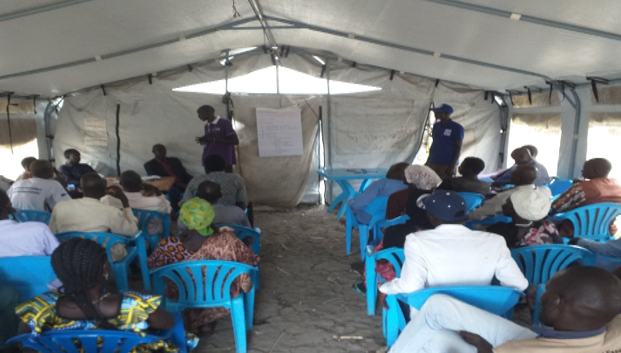
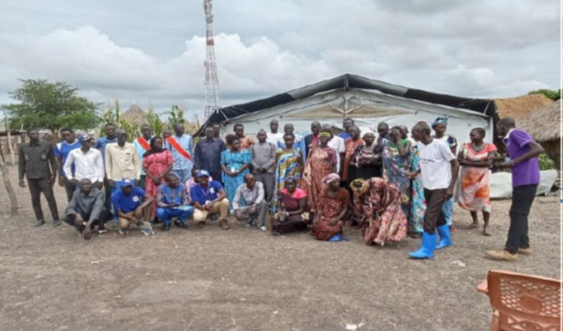
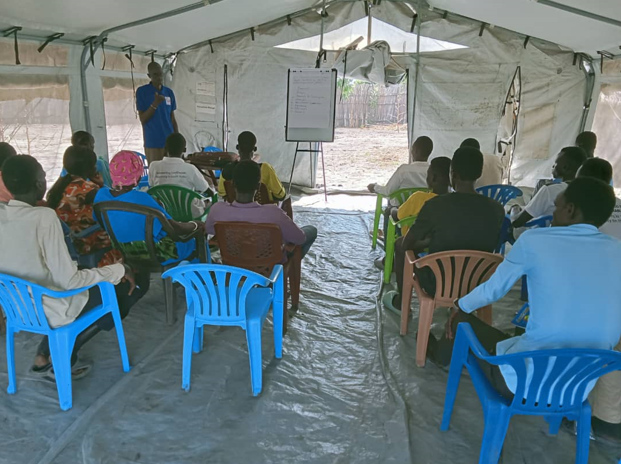
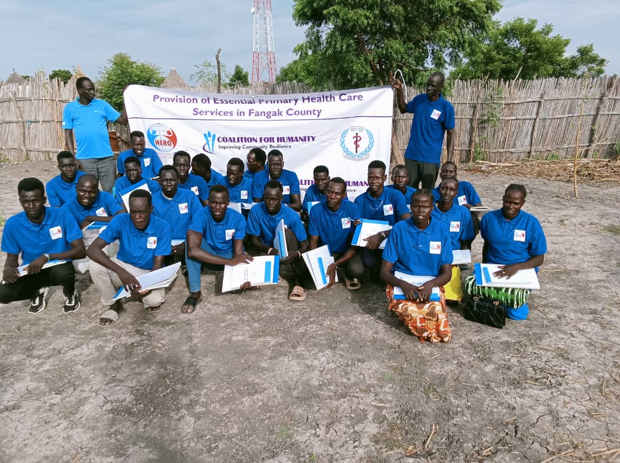
Photos: Project inception meeting and Boma Health Worker training — Fangak County, October 2024 (HERO / Coalition for Humanity)
Challenges & Solutions
- Supervision Access: Difficult movement to target locations due to flooding. Solution: Rental canoes identified for BHW supervision (one per payam) and mobile outreach.
- Equipment Transport Delays: River transportation of BHI equipment expected to take up to 8 days. Solution: Transport initiated in the first week of November 2024.
- Dike Breaches Disrupting Training: Flooding caused temporary suspension of BHW training. Solution: Training was rescheduled and completed.
Next Steps
Mobile clinic outreach activities in Lele, Tuongdiok, and Wuntur villages were planned to commence in November 2024. BHW field deployment was expected to begin following the arrival of BHI equipment from Juba. Ongoing coordination with CHD, RRC, and humanitarian partners continues to ensure complementary service delivery and avoid duplication.